Art(s)bestemmelse
- Year
- 2025
- Medium
- Photo series, 15 works – plants and finds in glass
- Exhibition
- 4 Meter Fald, Gjethuset, Frederiksværk 2025
Plants and finds from the landscape around Frederiksværk, collected in glass and given new, hybrid species names.
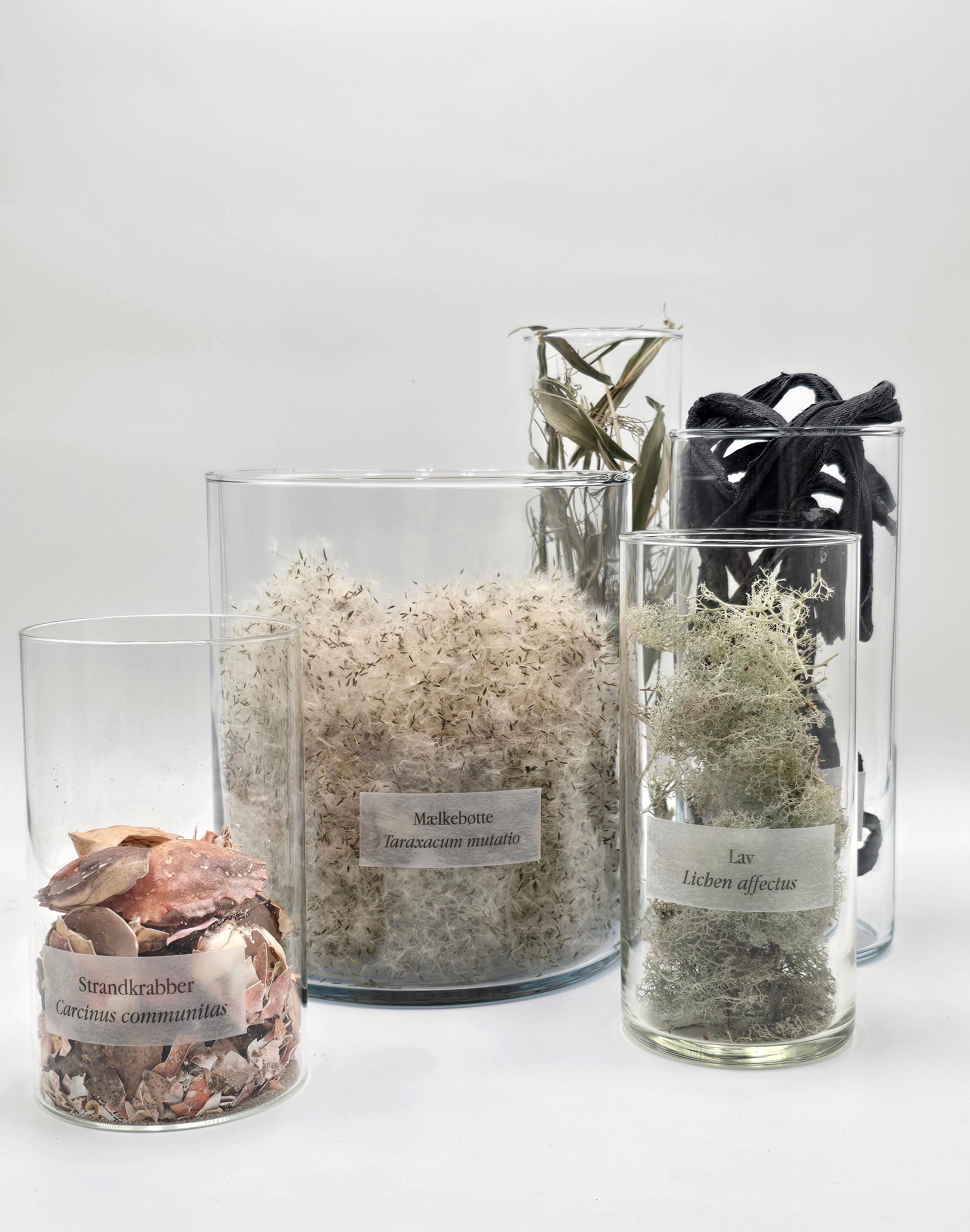
Doxa collectum
Doxa collectum is a selection of species that the landscape seems to keep after industrial society. Dandelion beside lichen, beside nettles, beside seaweed. Species that meet here under conditions they have all adapted to.
In psychology we know that transformation rarely begins in the community. It begins the moment an individual dares to see themselves clearly: the particular, the genuine. When the substance that has so far been kept within the limits of the norm is allowed to emerge, and those qualities find their way into the community, the hybrid becomes possible. Only then does something stronger than the individual parts arise.
Doxa collectum points to the landscape that emerges when species stop holding on to what everyone can agree on, and integrate diversity into a shared form. It is a biological and an inner process at the same time.
No. 1 Betula transitus
Birch catkins · Betula pendula / Betula pubescens
Betula transitus is neither one thing nor the other. As its Latin name suggests, it hangs in a state of transition, rooted in two species, with an identity that never quite lets itself be pinned down. Psychologically, this is not a weakness. It is a capacity – the ability to remain in the unresolved without falling. The catkins are collected, preserved and observed. They are witnesses to themselves.
No. 2 Lichen affectus
Lichen · Lichenes
Lichen affectus is not one organism. It is a negotiated coexistence, a relationship between fungus and alga that has lasted for millions of years. In that relationship, neither party survives alone under these conditions. What we call an individual always exists here by virtue of a community. Lichen affectus grows slowly, feels everything and forgets nothing.
No. 3 Buccinum pudoris
Whelk egg cases · Buccinum undatum
Buccinum pudoris carries its home with it. The shell is decorative like a story; layer upon layer of growth and pressure. Psychological research into bodily memory describes something similar – that traumatic and formative experiences change neural pathways and settle physically in the structure. Buccinum pudoris reminds us that form and experience belong together.
No. 4 Artemisia persona
Mugwort · Artemisia vulgaris
Artemisia persona is a plant that knows about masks. It grows willingly on the fringes of industry. It adapts its chemistry to the state of the soil and smells different depending on when in the day you approach it. In folk medicine it has been everything from healer to omen. Psychologically, Artemisia persona is a reminder that adaptation and authenticity are not opposites; they are a continuum.
No. 5 Pisum emergens
Pea · Pisum sativum
Pisum emergens climbs everything it meets. It sets its buds where no one sees them, inside the dense green mass, hidden behind leaves. Botanically and psychologically this is a survival strategy; hiding away what is most alive in oneself, because the individual is the most vulnerable thing to show. Always shielded from the greatest fear; being eaten, cast out or annihilated.
Pisum emergens carries shame as the conviction that what we are is not enough to belong. Pisum emergens blossoms anyway in order to survive; quietly, inwardly, on its own terms.
No. 6 Carcinus communitas
Shore crabs · Carcinus maenas
Carcinus communitas lives in the fluid zone between land and sea, a place in constant change. It sheds shell and carapace as it grows, and during those periods it has no protection; vulnerable, soft, new. Psychologically, this is an image of every kind of change – that for a while you must give up the survival strategies that have protected you, in order to grow stronger or to survive. Carcinus communitas is one crab and all the others. It is a necessary state when something new is on its way.
No. 7 Conus socialis
Cones · Picea abies / Pinus sylvestris
Conus socialis is a seed bearer. Every scale holds potential, but only under the right conditions does the cone open. Temperature, moisture, safety and time decide when the release happens. It is development created with patience under particular conditions. Conus socialis is named after the social dynamic that likewise needs particular conditions to develop. We observe. We wait.
No. 8 Natrix transformata
Grass snake · Natrix natrix
Natrix transformata bravely sheds its skin, metaphorically and literally. It leaves its old layer behind as a precise negative of itself – a form without content, an identity without a body. In Jungian psychology this is the process of individuation, where the old self is left behind so that something truer can emerge. Natrix transformata is collected in glass. The skin is there. The snake has moved on.
No. 9 Cuprum resonans
Copper · Cuprum
Cuprum resonans is left in the ground as part of a chemical archive of what was once made here. Copper conducts electricity, heat, time – and in its structure it bears traces of the hands that shaped it. Cuprum resonans conducts the collective identity in the shared work, the shared place and the shared loss. It settles in the body, in language, in unconscious actions and norms, and resonates between us. Cuprum resonans still lies in the soil of Frederiksværk. It is waiting to be acknowledged and reconciled.
No. 10 Taraxacum mutatio
Dandelion · Taraxacum officinale
For decades Taraxacum mutatio has settled in cracks, on industrial sites and along the edges of asphalt. Its spread follows no plan, but a pattern. With every seed head it sends its lineage on to new conditions. What is passed on is not only genes, but also the ability to survive the unfamiliar. Studies of Taraxacum mutatio suggest that the species thrives best where the disturbance is greatest. We call it resilience. Nature calls it survival.
No. 11 Pinus transfigurata
Pine bark · Pinus sylvestris
Pinus transfigurata has survived fire, wind and clearing. The bark is thick, the resin tough and dense. The tree is coded to cope under stress. In forestry terms it is a pioneer species. In psychological terms we call it post-traumatic growth. What sits in the bark is strength and sensory alertness in one – the ability to read sudden changes in a place and adapt in time. It is passed down through generations and embedded in the body. Pinus transfigurata is fragments of bark, like skin from a surviving landscape that has always known when to bend in order to survive.
No. 12 Fomes liminalis
Tinder fungus · Fomes fomentarius
Fomes liminalis grows in the borderland between life and decay. It lives on the dead tree and at the same time extends its story. In anthropology we call this state liminal – the threshold. It is neither inside nor outside, neither before nor after. Fomes liminalis is not a parasite. It works with deep, expanding changes that turn what can no longer be itself into something new.
No. 13 Saccharina collectiva
Sugar kelp · Saccharina latissima
Saccharina collectiva lives in what we cannot see from land. Beneath the surface, complex structures of light, current and nutrients take shape. The kelp has no individual intention, and yet it organises itself. Saccharina collectiva is named after the phenomenon that psychology calls collective affect – the shared emotional state that arises without anyone deciding it.
No. 14 Chondrus metamorphica
Irish moss · Chondrus crispus
Chondrus metamorphica changes colour with the light. In the shade it is dark purple. In the sun it turns yellow-green. The same organism, a radically different appearance. Biologists call it phenotypic plasticity. When it happens inside people, we call it something else. Chondrus metamorphica was collected on the coast at Frederiksværk and placed in glass. The plant is held in a single moment of its continuous transformation.
No. 15 Picea identitas
Norway spruce · Picea abies
Picea identitas grows in dense stands where the individual tree quickly loses itself in the mass. Yet every specimen is genetically distinct. The basic condition of the species is the tension between the collective and the particular – and perhaps it is ours too. In the landscape of Frederiksværk the spruce stood as raw material. Now the question is asked – what is left when the collective function is gone?